A pocket-sized probability puzzle
Coins, counters, and one surprisingly useful habit: count the possible outcomes.
Probability questions become less slippery when you can put every possible outcome on the table. These six puzzles use small collections, fair coins, and clearly stated rules. No knowledge of gambling is required; nothing here is a betting recommendation.
For each question, identify what counts as an outcome before reaching for a fraction. The explanations include the cases that people most often forget. All random selections in this quiz are uniform, and separate coin tosses are independent.
Give it a go
0 of 6 answered
Answers, with the working
Open an explanation whenever you like. Looking at the reasoning is part of learning, not a rule violation.
01 Two fair coins are tossed. What is the probability of exactly one head?
Answer: 1/2
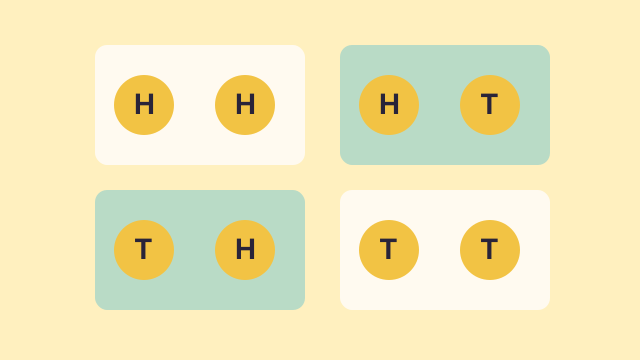
The four equally likely ordered outcomes are HH, HT, TH, and TT. Exactly one head appears in HT and TH: two of four outcomes, or one half. “One head” describes two arrangements, not one. Treating HH, mixed, and TT as three equally likely categories would hide that difference.
02 A bag holds 3 green counters and 2 orange counters. One counter is chosen at random. What is the chance it is orange?
Answer: 2/5
There are five individual counters, each equally likely to be chosen. Two are orange, so the probability is 2/5. The number of color names does not determine the chance. Two colors would give a half-and-half result only if the two groups contained the same number of counters.
03 A fair coin lands heads four times. What is the probability of heads on its next independent toss?
Answer: 1/2
Independence means the next toss does not consult the previous sequence. Its chance of heads remains one half. A long specified sequence can be unlikely before it happens, but once those earlier tosses are known, they are no longer uncertain events to include in the calculation for the next toss.
04 A bag has 2 blue counters and 1 yellow. You remove one blue counter without replacing it. What is the chance the next random counter is yellow?
Answer: 1/2
The remaining bag has one blue counter and one yellow counter. One of its two counters is yellow, so the probability is one half. The denominator changes because the first counter was not replaced. If it had gone back into the bag, the probability would still have been one third.
05 A fair six-sided die is rolled once. How many outcomes satisfy “even OR greater than 4”?
Answer: 4
The even results are 2, 4, and 6. The results greater than 4 are 5 and 6. Their combined set is 2, 4, 5, 6: four outcomes. The 6 belongs to both groups but is still only one possible roll. Adding the two group sizes without removing that overlap would count it twice.
06 You spin a wheel with 4 equal sectors numbered 1–4 twice. How many ordered pairs can occur?
Answer: 16
Each of four first-spin outcomes can be followed by any of four second-spin outcomes. That gives 4 × 4 = 16 ordered pairs. The pair (1, 3) differs from (3, 1) because order matters. A small four-by-four grid is a reliable way to see every possibility without relying on intuition.
Build a tiny sample space
Try drawing the four coin outcomes instead of remembering a probability rule. Then label the outcomes that meet the question. This separates two tasks that are easy to muddle: describing what can happen and deciding which events count as a success.
The counter questions introduce a different task: updating the situation. After a counter leaves the bag, redraw the bag. A calculation about the original collection can be perfectly correct and still answer the wrong question about the new collection.
An experiment you can reproduce
Make a grid with first-coin outcomes across the top and second-coin outcomes down the side. Mark the two mixed cells. Then toss two coins twenty times and record the results. Your observed share need not be exactly one half; a theoretical chance is not a promise about a short run. No visitor results are collected or used to manufacture an average score.
These scenarios and worked examples were written for Akkopo. Reasoning is shown on this page; fictional situations are not presented as observed data.
Something unclear? Suggest a correction.