Patterns that tell you the rule
No mind reading: every sequence comes with enough information to be fair.
A short list of numbers can fit many different rules. Instead of asking you to guess what a writer was thinking, these puzzles state the operation or provide a constraint that makes the requested answer precise. Your job is to apply it consistently.
There are five questions, including one that asks you to recognize when the available information is insufficient. That is a valid reasoning skill, too. A confident guess does not earn extra credit over a carefully justified answer.
Give it a go
0 of 5 answered
Answers, with the working
Open an explanation whenever you like. Looking at the reasoning is part of learning, not a rule violation.
01 Start at 4 and add 3 each time: 4, 7, 10, __. What comes next?
Answer: 13
The stated operation is addition by three. Applying it to the last value gives 10 + 3 = 13. You do not need to infer a hidden pattern from the first few values because the rule is explicit. This distinction matters whenever several possible patterns could fit the same starting list.
02 Start at 3 and double each term. What is the fourth term?
Answer: 24
Count positions as well as values: first 3, second 6, third 12, fourth 24. Doubling four times would produce the fifth term, 48. That is an indexing error rather than an arithmetic error. Naming the first position before counting operations prevents the off-by-one slip.
03 A lamp repeats red, blue, blue in a three-flash cycle. What color is flash 8?
Answer: Blue
The complete cycles occupy flashes 1–3 and 4–6. Flash 7 starts the next cycle with red, and flash 8 is its first blue. You can also use the remainder after division by three: 8 leaves a remainder of 2, placing it in the second position of the cycle.
04 The only information is the list 2, 4, 8. Is the next number uniquely determined?
Answer: No: more than one rule can fit
Doubling would give 16, but the list does not say that doubling is the rule. Another rule could match the first three terms and then produce a different fourth value. For example, adding successive even numbers gives 2, 4, 8, 14. A familiar continuation can be plausible without being logically forced.
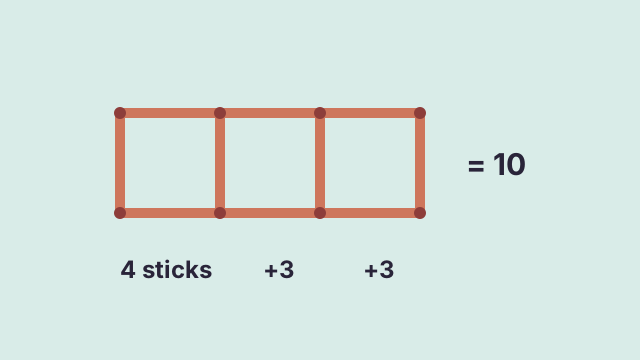
05 A row of adjoining squares uses matchsticks. One square needs 4 sticks; every extra square shares one side and adds 3. How many sticks for 5 squares?
Answer: 16
Begin with four sticks, then add three for each of the four additional squares: 4 + 4 × 3 = 16. Multiplying five by four would count shared sides twice. Drawing two squares first is enough to reveal the relationship before extending it to the full row.
Why the wording is part of the puzzle
A sequence question can be entertaining even when its intended rule is not unique. The problem starts when it presents one preferred guess as a proof of intelligence. Here, explicit rules keep scoring fair: a player should be able to point to the sentence that makes an answer follow.
For the matchstick question, the physical arrangement is part of that rule. Five separate squares require twenty sticks; five squares sharing sides in a straight row require sixteen. Removing the arrangement description would change the problem, not merely shorten it.
Make your own extension
Build a row of two, three, and four squares on paper. Record the number of new sticks at each step. You have created a small data table and an explanation for its pattern. The explanation is stronger than extrapolating numbers because it tells you why the increment stays constant.
These scenarios and worked examples were written for Akkopo. Reasoning is shown on this page; fictional situations are not presented as observed data.
Something unclear? Suggest a correction.