Three checks that catch an answer-shaped mistake
Units, reconstruction, and a small example can reveal errors that another calculator pass misses.
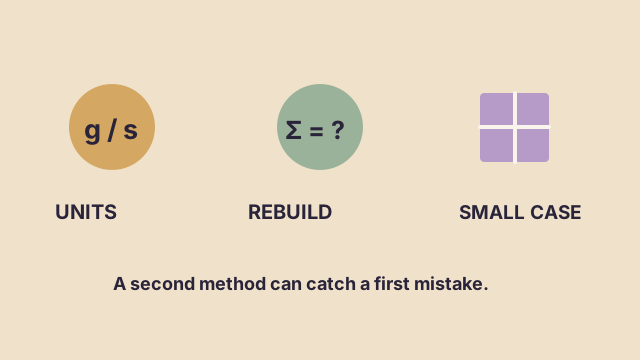
Check one: carry the units
Suppose a recipe uses 300 grams for four servings. Dividing gives 75 grams per serving, and multiplying by six servings gives 450 grams. The words cancel in the same sensible way as the arithmetic: grams per serving times servings becomes grams. A number without its unit loses that trail.
A shopping comparison works similarly. A 400-gram bag costing $7 has a unit price of $1.75 per 100 grams. Comparing that with another bag’s total price would mix two different quantities. The calculator could be accurate while the comparison remained meaningless. These invented examples are about arithmetic, not product recommendations.
Check two: rebuild the original
A $42 bill split equally among three people gives $14 each. If one person has already paid a $6 deposit toward their share, that person owes $8 more. Reconstruct the bill: 8 + 14 + 14 + 6 = 42. This check uses the proposed answer in the original situation rather than repeating the same division.
Reconstruction is especially useful when money or objects seem to have vanished in a word problem. Write every contribution exactly once. If the total is wrong, inspect whether a deposit was counted twice or an amount owed was mistaken for an amount already paid.
Check three: shrink the case
For a tournament where each of four players meets every other player once, list the pairs: AB, AC, AD, BC, BD, CD. There are six. The list makes it clear why four times three counts too much: AB and BA are the same match.
For a row of adjoining squares, draw two squares before calculating twenty. The shared side shows why each extra square adds three matchsticks, not four. A small case is not automatically a proof for all cases, but it can expose what the objects and connections actually represent.
Choose a different route for the check
If the first solution used a formula, use a drawing for the check. If the first solution was a list, use a total or invariant. Two methods that make the same assumption can repeat the same error, so independence matters more than the number of times you press equals.
For example, adding a 20 percent increase and a 20 percent decrease to get zero assumes the percentages share a base. A dollar-by-dollar reconstruction breaks that assumption open: $5 becomes $6, then falls by $1.20 to $4.80.
Know when the model ends
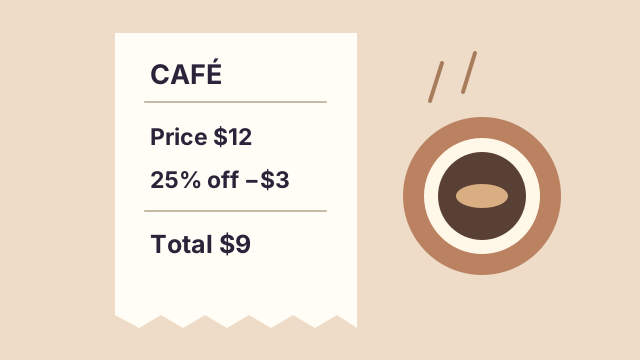
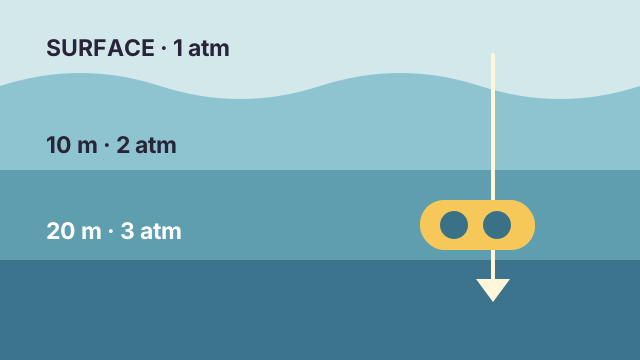
A correct calculation answers the model you supplied. It does not establish that the model captures a real decision. Our ocean quiz rounds a physical relationship for classroom arithmetic and explicitly excludes diving use. Our café ignores taxes and product differences because the questions state those boundaries.
When you finish a puzzle, add a sentence naming the assumptions. “Five blocks, along grid streets” is more informative than “five.” That short qualification prevents a result from traveling farther than the reasoning that supports it.
These scenarios and worked examples were written for Akkopo. Reasoning is shown on this page; fictional situations are not presented as observed data.