The Moon: familiar view, surprising details
A short sky quiz about moonlight, rotation, and the face we see.
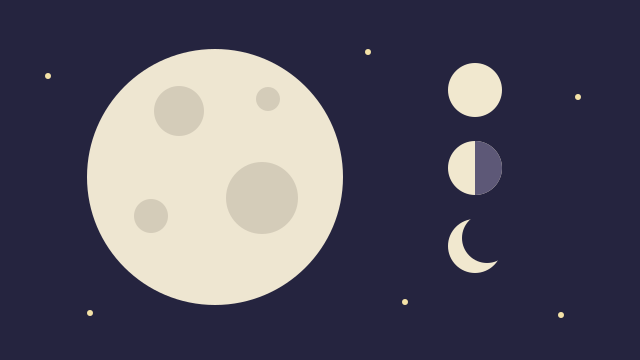
You do not need a telescope to enjoy looking at the Moon, but a few distinctions make the view more interesting. Light is different from illumination, rotation is different from orbit, and the far side is not a permanently dark side.
This short quiz focuses on those distinctions rather than on memorizing dates or exact measurements. The factual reference is NASA’s Moon overview, linked below. Our suggested paper-and-lamp model is an illustration you can try at home, not an astronomical scale model.
Give it a go
0 of 5 answered
Answers, with the working
Open an explanation whenever you like. Looking at the reasoning is part of learning, not a rule violation.
01 What makes the Moon look bright from Earth?
Answer: It reflects sunlight
Moonlight is reflected sunlight. The surface does not shine like a star. For a simple analogy, a white card near a lamp can look bright without producing light of its own.
02 Does the Moon rotate on its own axis?
Answer: Yes
Yes. Its rotation and orbit are synchronized, so approximately the same face points toward Earth. Walk around a chair while keeping your face toward it: your facing direction changes over a complete circuit.
03 Is the Moon’s far side always dark?
Answer: No
No. “Far” describes the side facing away from Earth, not a permanent lighting condition. A hidden side of a ball can still receive light; the observer’s viewpoint and the light source are separate.
04 What normally causes the changing lunar phases?
Answer: Our changing view of its sunlit portion
Phases reflect our changing view of the illuminated portion as the Moon orbits Earth. Earth’s shadow is involved in a lunar eclipse, a different event. A lamp and a ball can help separate those ideas.
05 Which description fits the Moon’s atmosphere?
Answer: A very thin exosphere
NASA describes a very thin exosphere. It is not an Earth-like blanket of breathable air. The visible surface should not be mistaken for an outdoor environment resembling one on Earth.
Try a model, then find its limits
Hold a plain ball at arm’s length with a lamp well off to one side. Change your viewpoint while keeping track of where the lamp is. The bright portion you can see changes even though the lamp keeps illuminating one side. Use a cool household lamp, avoid staring into it, and do not use the Sun as your light source.
The model is deliberately incomplete. Your room does not reproduce the enormous distances or orbital geometry of the Earth–Moon system. If your head blocks the lamp, you have introduced a shadow event into a demonstration intended to show phases. Recognizing that limitation is part of using a model well.
A useful question for the next clear evening
Instead of asking whether the Moon is “out,” try describing the shape of the lit portion and where it appears relative to sunset. A sketch with a date gives you something to compare on another evening. We do not collect observations or claim that this five-question score measures astronomy expertise.
Sources & scope
Reference checked October 24, 2026. Examples and explanations were written for this quiz.
Something unclear? Suggest a correction.